

PROJECT
Development of small optical connectors for devices - Realization of high-density optical cables -
Top / Research and Development / Development of small optical connectors for inside devices - Realization of high-density optical cables /Development of a small multifiber optical connector for delay with optical modules - Realizing high-density optical connectivities in next-generation data centers -
Copied to clipboard


Issues and Background of Data Centers
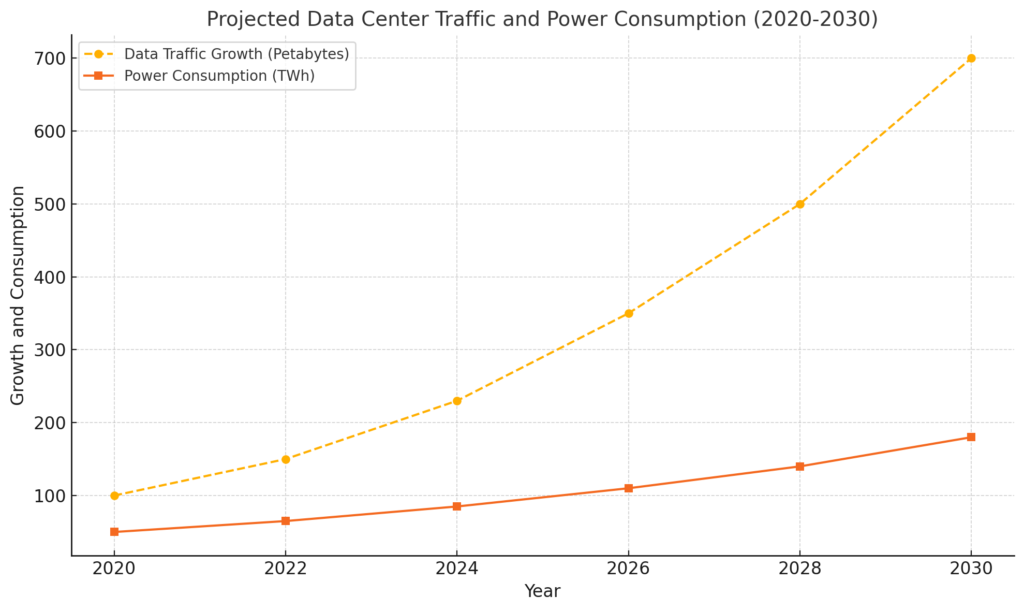
Demand for data centers is increasing rapidly with the spread of AI technology and the expansion of cloud services. Due to this growth, data communication volume is predicted to increase approximately sevenfold between 2020 and 2030. At the same time, this rapid increase in traffic will also lead to an increase in electricity consumption, with data centers as a whole expected to require more than 180 TWh of electricity in 2030 (see figure below).
To address this situation, the introduction of Co-Packaged Optics (CPO), a next-generation communications technology, is attracting attention. CPO achieves both energy-saving performance and improved bandwidth by integrating switching logic and optical I/O. However, this technology requires the use of compact optical connectors that maximize space efficiency inside switch boxes. Conventional MPO connectors have issues in being able to handle limited spaces and harsh temperature environments.
Our "MTCT® Connector" is an innovative solution to these problems. It not only supports the operational efficiency of data centers but also significantly contributes to the construction of next-generation communication infrastructure.
Development goals for MTCT® connectors
In developing MTCT® connectors, we have set the following three main goals:
- Realizing high-density optical connections
It enables many optical connections in a limited space, maximizing the functionality of devices. - Highly flexible structural design
Reassembly is possible even after MT Ferrule and optical fiber are fixed, allowing for flexible consideration of the assembly process flow. - Excellent environmental resistance
The product also meets the reliability evaluation tests (Telcordia GR-1435-2 compliant) required for multifiber optical connector in data centers, providing high reliability.
Features of MTCT® connectors
MTCT® connectors are designed to meet the stringent requirements of next-generation devices. Their features include:
- Compact design and high performance
The thickness is less than half that of conventional MPO connectors. It is also shorter in length than MPO-MPO connection structures, greatly improving space efficiency. - High temperature reflow compatible and reassembleable structure
The parts can be disassembled and reassembled even after the optical fiber is fixed to the ferrule, allowing for flexibility in the assembly process flow of the optical connector. - Adoption of high-precision ferrule technology
The "MTCOMPACT® Slim and Short" ferrule, which is one-quarter the size of a standard MT Ferrule, reduces the axial misalignment error of the optical fiber hole to less than 1 μm and maintains Insertion Loss at the industry standard of 0.7 dB or less.
Contributing to next-generation data centers
MTCT® connectors meet the needs of CPO switch designs developed by optical device manufacturers and AI-related manufacturers, offering the following advantages:
- Increased design freedom: Improved space efficiency allows for greater flexibility in internal design.
- Improve manufacturing efficiency: Rebuildable design reduces assembly costs.
- Provides high reliability: Provides stable performance over the long term.
Our company supports the resolution of challenges necessary for building next-generation communication infrastructure through MTCT® connectors. Please feel free to contact us for details and case studies.
reference
- Data center traffic growth (forecast to 2030)
Source: Minkenberg, C., et al., “Co-packaged datacenter optics: Opportunities and challenges,” IET Optoelectron., 2021, 15, 77–91.
We use the predictions for growth in communication traffic within data centers presented in this paper as a reference. - Data Center Power Consumption Forecast (Up to 2030)
Source: Goldman Sachs Insights
It is expected that the evolution of AI will lead to increased electricity demand at data centers.
Technical Background: Benefits and Challenges of Introducing CPO
- Source: COBO “Design Considerations of Optical Connectivity in a Co-Packaged or On-Board Optics Switch,” White Paper.
- Specific background information on CPO technology is provided.
Copied to clipboard
Upon request, we can share research and development information and provide samples.
Please feel free to contact us.
 PREV
NEXT
BACK TO LIST