

ICSJ2026 Participation Report | Next-Generation Optical Connectivity Technologies Seen in Cutting-Edge Packaging and Photonics


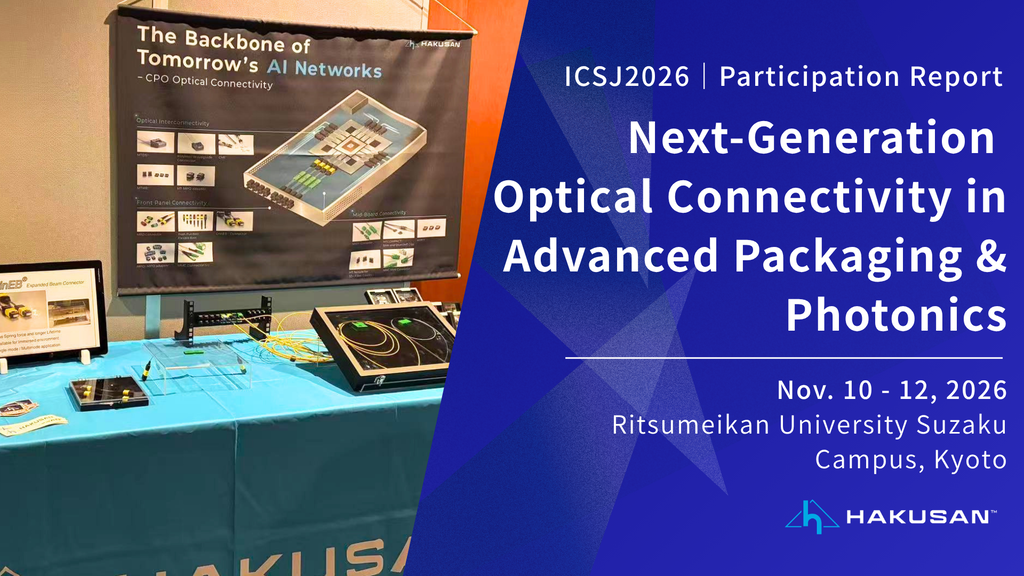
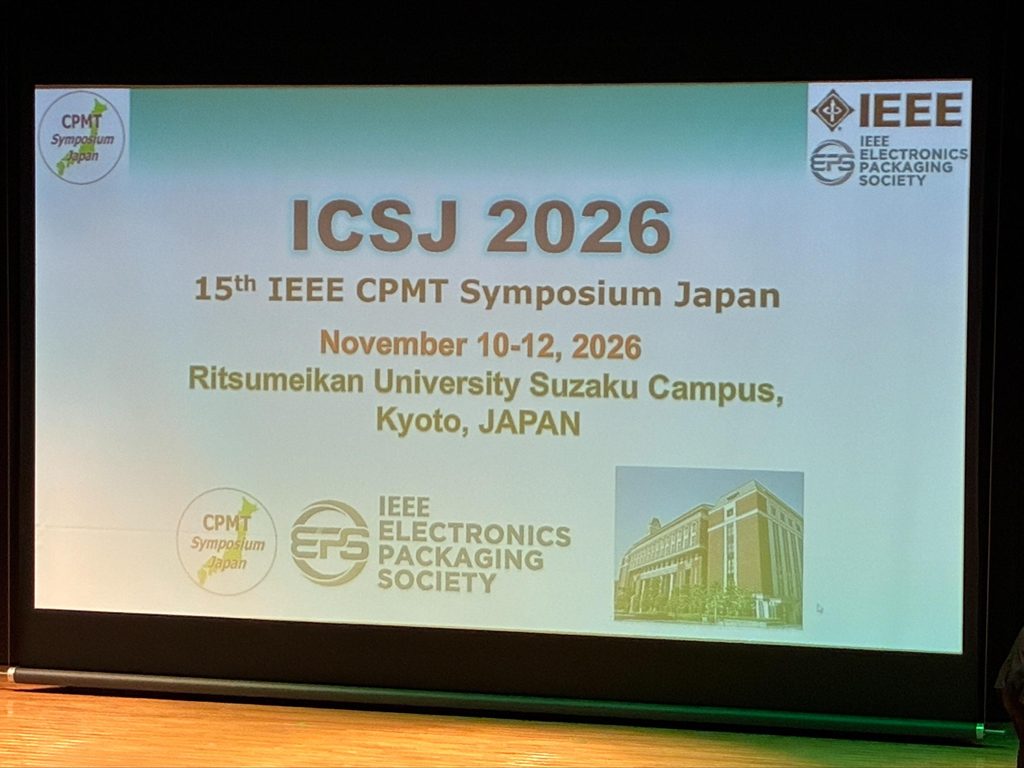
Hakusan Inc. participated as a welcome reception sponsor in "ICSJ2026 (IEEE CPMT Symposium Japan 2026)," which was held at Ritsumeikan University's Suzaku Campus from November 10th to 12th, 2026.
ICSJ is an international symposium where research results and cutting-edge technologies related to advanced electronics packaging, semiconductor packaging, photonics, and optical interconnects are presented. Researchers, engineers, and industry professionals from Japan and abroad gather to engage in active technical exchange through seminar and exhibitions.
What we learned at ICSJ2026: Steps toward the practical application of CPO
During the conference, technical seminar were given on a wide range of topics, including photonics, CPO, advanced packaging, and processes and materials.
What was particularly impressive was the discussion that went beyond simply whether CPO (Core Product Officer) could be "technically realized," to how to "implement, evaluate, and bring it to mass production."
As the volume of data handled in data centers increases with the spread of AI, CPO (Cyber-Polluted Optics) technology is being developed to shorten the distance of electrical wiring and address challenges related to power consumption and signal quality. However, there are various challenges to overcome before mass production, including connecting the optical engine and PIC (Photonic Integrated Circuit) to optical fibers, mounting them on substrates and packages, and integrating them into the manufacturing process.
Furthermore, CPO's system configuration and optical connection methods are still under development, and further discussion is needed regarding evaluation methods. seminar suggested that we are moving beyond the performance of individual components and are entering a stage where we must consider the entire ecosystem, including interfaces, implementation, and evaluation.
How to connect a PIC microcontroller to an optical fiber
From the perspective of Hakusan, a manufacturer of optical connectors, what we found particularly interesting was the connection between PIC microcontrollers and optical fibers.
In CPO (Core Processing Unit), it is necessary to connect the PIC (Microcontroller) that handles optical signals with external optical fibers with high precision. As optical engines become smaller and more densely packed, it becomes crucial to ensure coupling accuracy, ease of implementation, and mass production capabilities while arranging a large number of optical fibers in a limited space.
Therefore, the scope of consideration for optical connectivity has expanded from the traditional question of "how to connect connectors to each other" to "how to connect optical devices and fibers within packages and substrates." A perspective that considers the entire optical interface, including the PIC microcontroller, fiber, package, and substrate, is becoming crucial.
Hakusan believes that Multifiber connection, high-precision positioning, and mass production technologies it has cultivated in optical connectors can be applied to optical connections in these "device-closer areas." In addition to connection reliability and ease of handling as a connector, the challenge going forward is to propose structures and mounting capabilities that take into account connections with PICs, packages, and circuit boards, within the overall optical interface.
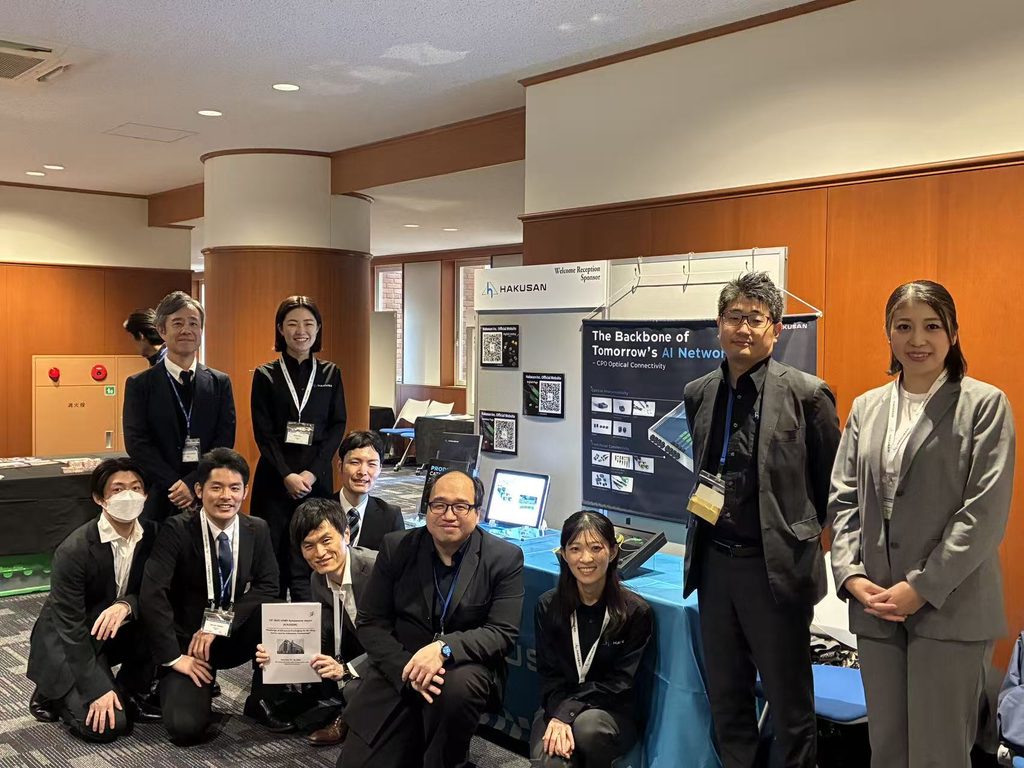
Interest in CPO and high-density optical connectivity was observed at the exhibition booth.
At Hakusan exhibition booth, we showcased Multifiber optical connection technology with a view to applications in AI data centers, next-generation optical communications, and CPO (Core Processing Unit).
In particular, there was significant interest in GrinEB® connectors, CMF®, and Narrow-Pitch MT Ferrule (MTDS®) intended for connection with glass arrays (Fiber Array Units: FAUs). Specific information was exchanged regarding mounting methods on boards assuming CPO (Core Processing Unit) configurations, and configurations for connecting PICs and optical fibers.
In particular, regarding the connection of reduced cladding MT Ferrule and Narrow-Pitch MT Ferrule to FAUs, we received specific questions about implementation, such as the number of cores, structure, and where they could be used within the CPO. It was evident that there is growing interest in optical connections that consider the entire CPO system, including not only the performance of individual products, but also fiber routing and implementation space.
From "technically possible" to "mass-produced."
What was particularly impressive about ICSJ2026 was that discussions on next-generation optical connectivity technologies, including CPO, are progressing beyond the performance of individual components to include questions like "how to implement, evaluate, and mass-produce them."
As density and miniaturization progress, next-generation optical connections increasingly require a perspective that includes not only connection performance, but also implementability, reproducibility, and mass production feasibility.
Hakusan will use the challenges and needs identified through this technical exchange to inform future product development and proposals for optical connectivity solutions. Together with research institutions, engineers, and industry partners, we will work to advance optical connectivity technology that will support next-generation communication infrastructure.
We would like to express our sincere gratitude to everyone who visited Hakusan booth at ICSJ2026, and to everyone who gave us the opportunity to exchange technical knowledge.
If you have any questions or inquiries about our company,
Please feel free to contact us.
